Backrooms
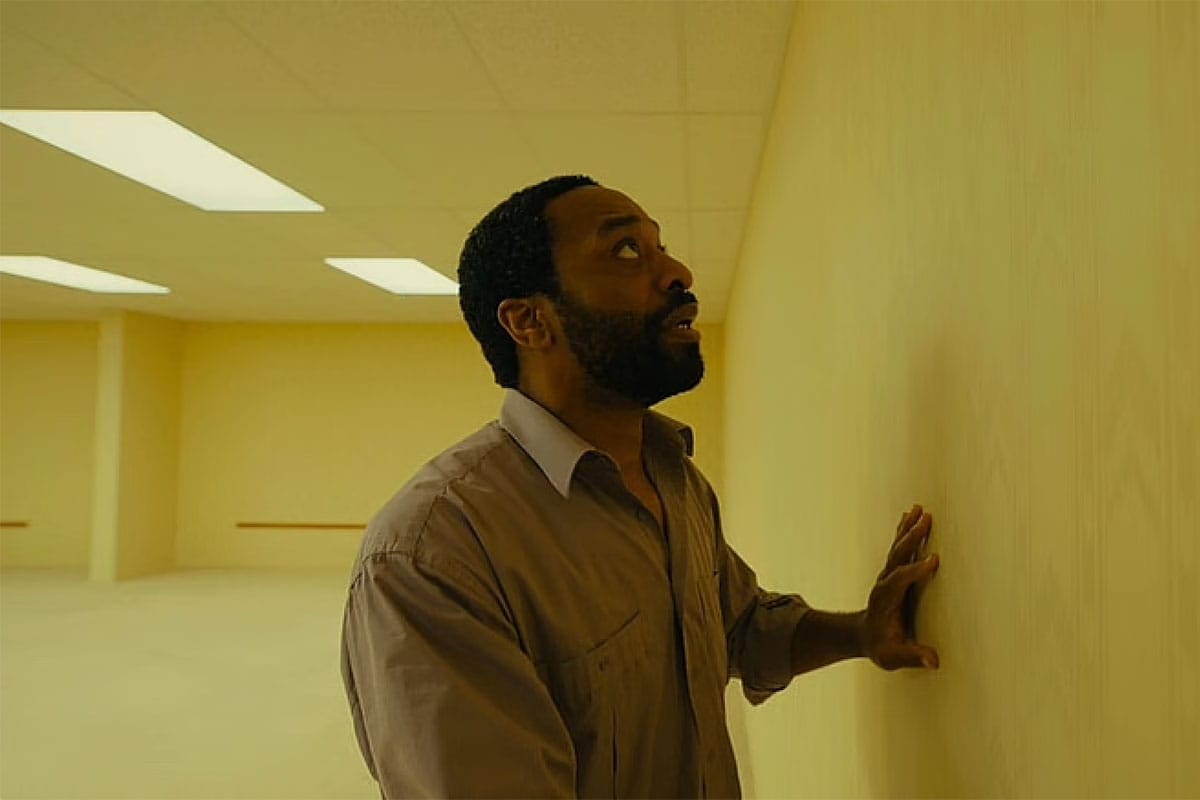
If "Backrooms" is to start a trend in our ever-evolving content pipeline, right now there is a teenager constructing the framework for a 2032 box office smash in Fortnite's Creative mode, probably based on a copypasta he read on Discord. That's because the origin of the latest horror hit "Backrooms" is not the "twisted mind of" a directing wunderkind, but an even darker place: the seedy servers and terrifying threads of 4Chan and Reddit. And its creator was not a prodigy of film, but rather of software, of mood, of mythopoeia.
Kane Parsons, the movie's 20-year-old director, has elevated a YouTube series born of something like an anonymous writing prompt into a legitimately gripping feature debut. He has seamlessly transitioned his canvas from Blender, a free and open source software used to create 3-D models, to a 30,000-square-foot soundstage in Vancouver, replacing fully digital characters with Oscar nominees Chiwetel Ejiofor and Renate Reinsve, and crafted a visually interesting and thematically layered film that is literally nothing but vacuous, redundant spaces but never feels empty or repetitive.
The concept of Backrooms comes from a 2011 4chan post which, accompanied by a photo of an empty office space not unlike the ones displayed in the film, said this:
"If you're not careful, and you noclip out of reality in the wrong areas, you'll end up in the Backrooms, where it's nothing but the stink of old moist carpet, the madness of mono-yellow, the endless background noise of fluorescent lights at maximum hum-buzz, and approximately six hundred million square miles of randomly segmented empty rooms to be trapped in.
This became a public source IP of sorts, with many online users iterating their own digital worlds or narratives off this premise. Parsons' work, grounded by a VHS-filter and bolstered by a sinister, sinuous backstory involving corporate conspiracy and creatures of ambiguous origin, became synonymous with the Backrooms concept despite it not being his invention. It's a landmark development, somewhat rooted in the ground Rooster Teeth broke with their "Red vs. Blue" series, which used the Halo universe and its polychromatic soldiers to create a web series parodying war and sci-fi. "Backrooms" strikes a far darker tone, though, and having been derived from a much thinner premise, offers a structurally appropriate set of endless possibilities.
The seminal idea of Backrooms is "noclipping," which is more or less a way to describe a glitchy process in video games where a player might fall through a specific part of the map, winding up stuck there and unable to re-join the game (I remember many late nights in middle school trying to accomplish this feat in Gears of War). While its a rather horripilative concept, the brief glimpse we see of the portal into this liminal space in "Backrooms" is alluring, as if glancing through a window into a different galaxy.
For the film's main characters, even while overcome with fear and confusion in their new setting, the Backrooms represent a tantalizing escape from empty, isolated lives. Before either crosses the barrier into this twisted dimension, they are already trapped by typical constraints of human life: childhood trauma, relationship and professional turmoil, an all-consuming dreariness. Reinsve's Mary is a therapist guiding Ejiofor's Clark through a period of marital strife, sputtering sales and deep-seated resentment regarding his fraying aspirations of an architectural career. By the end, one of the characters is seemingly more at peace with the rules of this newly discovered world than the one on the surface.
Although the screenplay for "Backrooms" was written by Will Soodik, it is nonetheless impressive that Parsons renders textual and subtextual material well beyond his years so intriguingly. In theory, a horror movie directed by a 20-year-old conjures the expectation of something gory and explicit with densely packed scares that placate the fried synapses of the TikTok generation. But "Backrooms" is neither that nor is it simply a hypnotic, monochromatic ocular maze that breaks the spell with freaks and frights. Rather, the most unsettling things about the movie are the thoughts it leaves you with.
And that the director is 20 years old is not for the sake of novelty. His perspective is essential to the cohesiveness of the film, for this is a movie rife with the terrors of the modern age, those stunting and stagnating Parsons' generation.
For starters, it is easy to see the Backrooms as an allegory for the vast cyberspaces that consume an increasing amount of young people's free time. Generation Z is the first human cohort for whom it is entirely possible to spend the majority of their waking hours engaged (or perhaps ensnared) in purely digital, online worlds. Twitch streams, TikTok scrolls, YouTube content like Parsons' original works - a cascade of content so sprawling that it becomes mundane, its effect increasingly muted. Even role playing within open-world video games has become popular across Minecraft, Roblox, Fortnite and Grand Theft Auto. The result is not a bifurcation of the persona, but rather the thinning of the barrier between the pure and pixelated worlds to the point of imperceptibility.
But what brought society to the doorstep of the Backrooms? Parsons has an idea. The movie's present-day narrative is spliced with flashbacks to Mary's own traumatic childhood, when her paranoid mother kept her locked inside her house, with boarded up windows and blocked off doorways. Mary not being allowed to leave her house as a child is a parallel to a generation of kids who were locked in their homes during the pandemic, suffering psychological damage en masse that can't properly be assessed or abandoned. Parsons was a high schooler when COVID-19 shutdown the world; his first Backrooms YouTube video was posted in November 2021, so at least someone used that time to enhance their career prospects.
Given its pointed commentary on modern times, it's worth wondering why this movie takes place two decades in the past. The obvious answer is that a movie set in the 90s enables an era-appropriate use of the VHS camcorder, and the faux-tape footage provides the most engrossing moments of "Backrooms." It, of course, also eliminates the cell phone problem. It is 2026, after all, when Los Angeles teens are posting "Scientology runs" on a daily basis, so clearly today's youth would have had no problem descending upon Captain Clark's Ottoman Empire in droves to thrust themselves into the labyrinth, livestreaming the whole affair and forcing some sort of large-scale governmental action.
On that note, the degree to which the powers that be are aware of the Backrooms isn't clear in the movie, at least not to someone who has no relationship with the preexisting lore. Mark Duplass' Phil character is shown sparsely in the film, but it's clear from early on that he is a scientist entrusted with a secret mission to observe the developments in the Backrooms, though the ultimate purpose is never revealed (did someone say "sequel"?). It also isn't clear whether the Backrooms are a naturally-occurring phenomenon or if it is something the government or a corporation is in control of.
So we don't know how things are happening, but it is clear what is happening: Things are being copied ad infinitum, specifically everything on the ground level of Clark's furniture store. Most of the Backrooms are filled with replicas of his products (stools, chairs, couches), but crucially there are also people, or at least facsimiles of them with varying degrees of vasculature. Underground copies of humans is something we've seen depicted in high-brow Sci-Fi shows like "Severance" and "Westworld," but the duplicates here more closely resemble those in Jordan Peele's "US." Disfigured, mostly lame, an existence and a purpose that isn't clear.
The distorted appearances of the copies and even the physical spaces themselves more than hint at the movie's most prominent subtextual topic: Generative AI. The copies of humans in "Backrooms" have misaligned eyes, multiple noses, several faces grafted onto one head. The floors go on forever, with each iteration somewhat different, often worse and more bizarre; chairs sink further into the ground, couches hang on the wall. This is precisely the experience that services like ChatGPT provided in their infancy, generating nonsensical slop ineffectively and inefficiently. The film underscores that AI-generated content is not just eclectic ephemera and that it comes at a steep cost. Clark is beseeched by mounting electric bills and erratic power outages, which are a direct result of the power being stolen and wasted by the Backrooms.
Given that the movie is set in the 90s, it makes sense that this never-ending series of rooms is manifesting itself underground. Back then, the common perception of the Internet was that it was occurring beneath us through a network of vast underground cables. As time went on, "the cloud" entered the nomenclature, so the Internet briefly took on the identity of something intangible, beyond our grasp. Of course, in recent years, what "the cloud" actually means has become more understood as data centers pop up across the world and compete with humanity for space and natural resources. Were "Backrooms" set in the 2020s, perhaps this analogy would manifest itself in the form of an ever-expanding server farm, like the SolidGoldMagikarp facility in Ari Aster's prescient "Eddington." Instead, the limitless expanse of history is contained underground in "Backrooms," its impact growing in every direction.
It is interesting to see the past rendered this way, like revisiting the draft history of a Word document in 3-D. The detritus of our memories has distended from shoe boxes and photo albums to an infinite number of selfies, texts, emails and game saves, all stored in a computational warehouse that drains our lakes and pollutes our air. With these new methods of serialization, much more of humanity's dark side will be preserved than when human beings got to decide how each other was be remembered. Our flaws will take up even more space in the Backrooms of the data centers than will our feats. The cotton-filled caricatures of our grandparents that we carry with us will be the last of selective recollections; our warts and cysts will persist - and bleed when our progeny confronts them.
One could argue that "Backrooms" doesn't implicitly intend any of these interpretations. It's true that the nature of the film's design allows for viewers to construct their own mythology, which is in and of itself one of its positive prescriptions. In an age when algorithms curate taste and shape understandings of the world, starting with a blank slate, filling it with just enough content and more than enough craft to generate attention, and asking the audience to form their own conclusions is a creative exercise humanity could use more of.
)